



By Ryan Stowers, senior vice president at Stand Together
Although the team’s origins date back to 1946, today’s Atlanta Hawks are an NBA franchise with complex business needs. From analytics and data to entertainment and facilities, the organization has evolved into an employer with significant demands on both its operations and talent.
For the Hawks — and for companies in other industries — the customers, jobs, and pressures of today might not be the same tomorrow.
Whatever the future holds, the Hawks remain agile by fostering an innovative culture built on long-term investment in their people. First, the Hawks prioritize the individuality of all their employees. Next, the team creates pathways to opportunity based on how the employees’ unique strengths, behaviors, and skills align with the Hawks’ business priorities. While some employers still rely on typical benchmarks like degrees or titles, this talent strategy has helped the Hawks close workforce gaps and prepare for the surprises coming down the court.
“Our future depends on embracing skills as the measure of potential and breaking free from the limits of tradition,” said Camye Mackey, the Hawks’ executive vice president and chief people, diversity, and inclusion officer. “If we stay confined to conventional approaches, we’ll only replicate the past.”
“To thrive in an increasingly complex world, we must pursue bold, transformative outcomes that unlock new possibilities,” she added. “Our complexities demand innovative, future-ready solutions, not more of the same.”
The key to closing talent gaps
Imagine two teams trying to play basketball on a court with a gaping hole in the middle. Unfortunately, many businesses face a similar challenge. Nationwide, numerous employers and workers are separated by skills gaps that keep both parties from achieving their goals.
Skills gaps exist when the skills employers need to fill jobs — and the skills potential talent have — aren’t aligned. Mackey says skills gaps often stem from outdated hiring and retention practices, such as job descriptions that fail to reflect actual needs, limited visibility into how skills transfer across job functions, and automated hiring systems that may unintentionally screen promising workers out of the talent pool.
“It’s a disconnect, I think, on both sides,” she said. “And solving it requires more inclusive, skills-based approaches to hiring and just general development of people.”
Skills gaps are increasingly the obstacle to economic mobility. For instance, Opportunity@Work estimates that over the past 20 years, 70% of emerging jobs have listed a bachelor’s degree as a requirement, even though only 40% of Americans have one. Opportunity@Work is a nonprofit that aims to connect employers with workers who became skilled through alternative routes, such as military service, workforce training programs, or on-the-job experience. Per Opportunity@Work, 70 million working-age people in America have backgrounds like these.
The good news? It doesn’t have to be this way. When employers look past pedigrees and see workers’ singular abilities, histories, and motivations, skills gaps disappear.
“For workers, it creates new pathways to grow, reskill, and access opportunities that might not have been traditionally thought of,” Mackey said. “It is a more inclusive and future-ready approach.”
“For our team, it means identifying each person’s strengths and aligning them to where they can have the greatest impact,” she added.
Mackey cites one Hawks team member who demonstrates the organization’s forward-thinking talent philosophy. Starting in a creative marketing role, this employee took the initiative to expand her expertise in sports management. By fusing creativity with sharp business acumen, she not only transformed her career but also delivered innovative, data-driven solutions that elevated the Hawks’ basketball operations. Her dedication and forward-thinking approach allowed her to move from the Hawks’ business side to a pivotal leadership role within basketball operations, demonstrating the power of continuous learning and skill development. Mackey says this progression is one that other employers can learn from.
“We’re having great outcomes as a result of this,” she said. “We’re finding that her capacity — her scope to do more — has increased.”
“I really think that’s the way of the future,” Mackey continued. “It’s looking at skills and how we can leverage them in different ways that aren’t traditional.”
‘True to Atlanta’ — and workers
What does the Hawks’ culture look like on the ground? Mackey says it’s an environment where adaptability, results, and teamwork are the most desired attributes.
“These are qualities that aren’t always reflected by a degree,” she said. “It’s about performance. It’s about fit.”
“You can’t have everyone who’s a point guard,” she added. “You need a nice mix to make it all work together.”
The sun at the center of the Hawks universe is the team’s “True to Atlanta” motto. A major part of the Hawks’ culture is keeping their talent engaged with the community the franchise calls home.
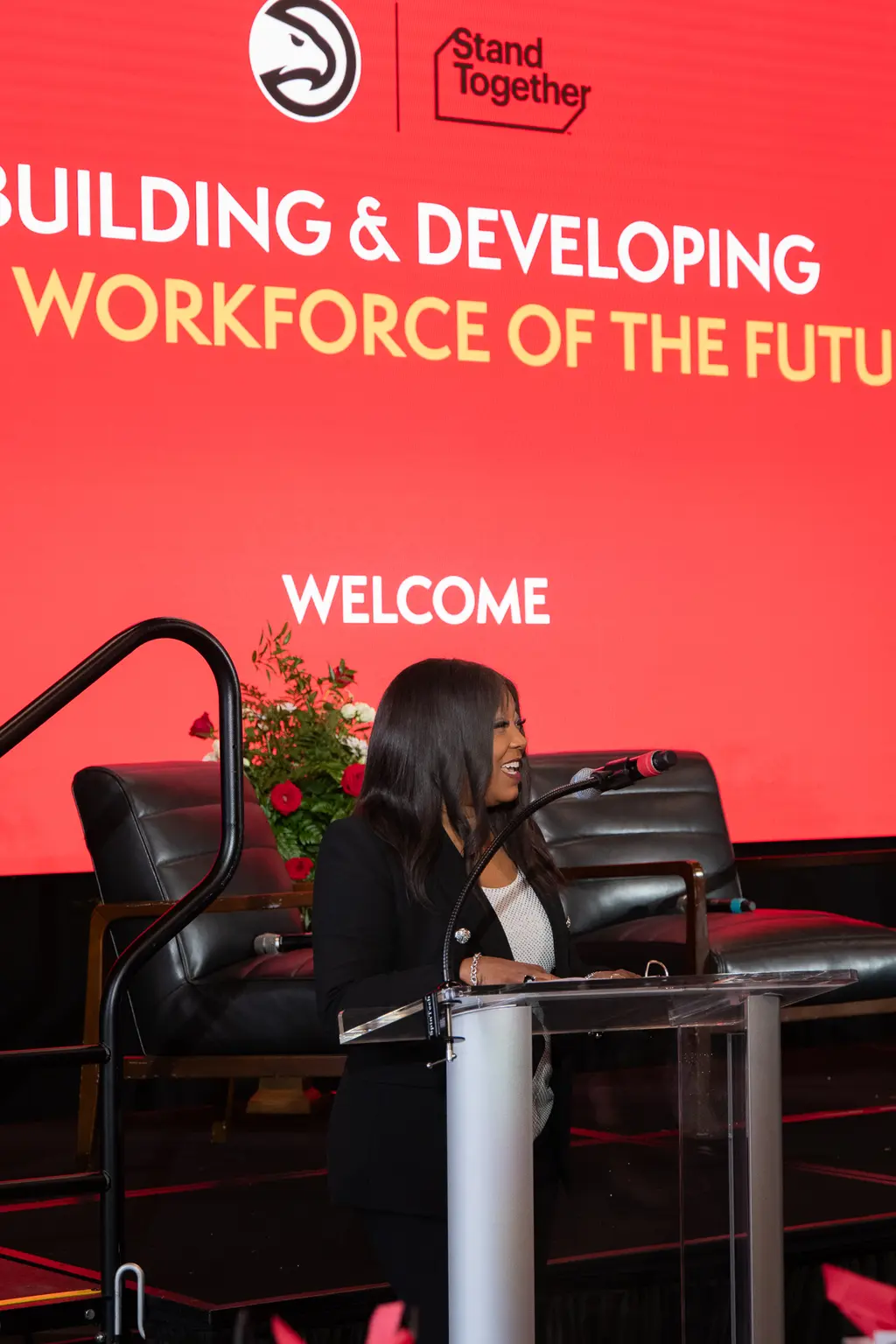
Consider the Building & Developing Your Workforce of the Future event that the Hawks cohosted in partnership with Stand Together at Atlanta’s State Farm Arena in May 2025. The event featured three panels, with subjects including attracting and nurturing high-potential individuals and rethinking retention strategies for a new generation of workers.
Mackey was one of several Hawks leaders who participated in the networking opportunity. During an exclusive interview, she emphasized the importance of diverse backgrounds, experiences, and thoughts. One of the night’s biggest messages was that talent doesn’t always turn up with conventional credentials.
Stay up to date
“Life experiences are inclusive of past roles, experiences, and exposures,” Mackey said. “Often, when you dig deeper, you discover skills the person possesses that weren’t initially apparent.”
“What skills and experiences does this person bring to the table?” she added. “You don’t know what skills someone has until you dig deeper and provide them with an opportunity."
Another way the Hawks are helping advance a new talent paradigm is by participating in the Who Are You™ movement. Launched in May 2025, Who Are You, or WAY, is a platform for alternative career pathways that connects learners to resources that help them explore their individual gifts and talents and create real career momentum.
Melissa Proctor, the executive vice president and chief marketing officer of the Hawks and State Farm Arena, is one of several luminaries across the business, music, sports, and tech worlds who have added their voices to WAY. WAY envisions a world where meaningful lives and careers are built around one’s true self, rather than societal expectations.
“You’re educating and exposing individuals to new ways of working and operating,” Mackey said of the Hawks’ partnerships. “You’re going to get a wider talent pool.”
“It helps us think innovatively, to think outside the box,” she added. “It helps us with our future workforce.”
Lessons learned from the talent frontlines
Mackey says the Hawks’ Virtual Sales Academy is another example of the organization’s inventive talent practices. She noted that the academy “actively combats degree biases” through its novel approach to upskilling.
Upskilling is when people learn new abilities to grow their skill sets. The latest edition of the Hawks’ academy aimed to provide part-time team members at State Farm Arena with professional training to learn the language of sales. The program lasted six weeks, with 33 participants — ages 20 to 70 — participating in interactive modules designed to offer learners a hands-on introduction to sales in the sports business.
Because many of the latest academy’s learners work in concessions, it offered them the chance to imagine success in sales. And what workers imagine, workers can achieve. For the Hawks, the academy revealed untapped internal talent. These concessions workers attend almost every Hawks game, meaning they’re already deeply dedicated to the organization’s activities.
“Many of these employees never thought they could have an opportunity in sales,” Mackey said. “It shows them that they can do this.”
“Once the employee has confidence, they’re more apt to try new things and share ideas that they have,” she noted. “I believe that leads to better outcomes for the organization.”
Each of the academy’s six weekly meetings prioritized group interactions, role-play, and continued learning. Participants met with the Hawks’ sales leadership for two hours every Friday, with lessons covering scheduling appointments, working through objections, and using and developing sales scripts. Learners also engaged in mock sales calls with members of the Hawks’ sales staff, receiving real-time feedback in small breakout rooms.
The learners even received professional headshots from Stand Together, which partnered with the Hawks on the endeavor.
The academy is another moment where the Hawks’ “True to Atlanta” slogan rings true. The Hawks conducted the academy’s training in partnership with Per Scholas’ Atlanta chapter. Per Scholas, a national nonprofit that advances economic mobility through immersive training for technology careers, provides talent to more than 300 companies in the Metro Atlanta area.
“In sales, there’s unlimited earning potential,” Mackey said. “When you think about economic mobility, this is helping individuals, families, and our community rise.”
“It was the art of possibility,” she continued. “It changed lives at the end of the day because of that exposure and access.”
On innovation and culture
Every day, employers of all stripes face the same uncertainty about what’s next. With technology only accelerating disruption, they need every advantage to keep up.
The Hawks are meeting the moment by expanding their roster of talent. Rather than relying on the pedigree-based hiring, recruiting, and retention of the past, they’re wielding an approach founded on abilities and attitudes that’s the future.
For employers everywhere, the lesson is that embedding pathways to opportunity in your culture is a strong shield against anything over the horizon.
“We attract, train, and retain talent by partnering with organizations that share our values around access,” Mackey said of the Hawks.
“We build a strong, diverse pipeline for future roles,” she continued. “That’s exactly what we want. And that’s what most employers want.”
Ryan Stowers is a senior vice president at Stand Together and executive director of the Charles Koch Foundation, which, as a member of the Stand Together community, partners with changemakers who are tackling the root causes of America’s biggest problems.
This article was originally published on Forbes BrandVoice. Check out more stories on the future of work on our page.
The Stand Together community partners with changemakers who are tackling the root causes of America’s biggest problems.
Learn more about Stand Together’s efforts to transform the future of work and explore ways you can partner with us.
The key to closing talent gaps is closer than many employers think

How to make work more human

Why skilled workers keep getting filtered out of jobs they qualify for