




Ask people today, and you will hear the same thing again and again: keeping a roof over your head has never felt this expensive. What is harder to pin down is why. Most families can feel the squeeze, but few can point to what is actually causing it. The truth is that it is not one problem. It is a handful of long-building issues, all landing at once, in the numbers every American family is living through right now.
The housing shortage, and the cost-of-living squeeze it feeds, isn't a mystery. It's the predictable result of decades-old rules about what can legally be built. And the fastest fixes are already being tested by cities, states, and communities right now.
Why is housing so expensive?
In short, housing is so expensive because rules made it illegal, or prohibitively expensive, to build enough of it, and wages never caught up with rents. Median rents have risen 21% since 2001, while real wages grew just 2% over the same period. Since 2017, rents are up 50% and home prices have increased 80%.
Nearly half of all renters, 49.7%, are cost-burdened, spending more than 30% of their income on housing. And 22% of renter households now spend more than half their income on rent, an all-time high. This isn't confined to low-income households. Middle-income renters and first-time buyers in high-demand cities are getting priced out of homeownership entirely, which is one reason so many people are asking why the cost of living is so high more broadly.
Two causes compound each other. Restrictive zoning locked in a mid-century vision of housing that no longer fits the country, banning the duplexes, triplexes, and small apartment buildings that used to be normal in most neighborhoods. Most of the zoning rules that govern American neighborhoods today were written when just 7.7% of Americans lived alone. That number is 27.6% now, and about 75% of U.S. residential land is still zoned exclusively for single-family homes. The rules never caught up with how people actually live, and that gap explains a lot about why houses are so expensive today.
On top of that, permitting delays and rising construction costs slow down building even in places where it is technically allowed. The result is a gap of 7.3 million rental homes that are affordable and available to extremely low-income renters, a gap that widens every year. This is why home prices are so high even in cities that aren't adding many new residents. Supply simply has not kept pace with need.
If more supply is the fix, why doesn't everyone believe that?
Most people misjudge how housing markets work, even though they understand supply and demand instantly in other markets. A Journal of Economic Perspectives study found that 86% of people correctly predict how a supply shock affects used-car prices, but only 35% predict that more housing supply lowers home prices.
That gap in understanding has consequences. It pushes people toward blaming landlords and developers rather than the regulations restricting supply, and toward popular but often counterproductive top-down fixes like rent control. The actual lever is simpler: make it easier to build homes, and see what happens.
Stories that inspire, in your inbox.
What happens when cities and states actually change the rules?
When cities and states remove the barriers, supply responds and prices follow. Minneapolis is the clearest proof of concept. In 2019, it became the first major U.S. city to eliminate single-family-only zoning citywide through its 2040 Plan. The headline reform wasn't the biggest driver of new supply, though. Removing parking minimums and enabling transit-oriented development did more of the work, helping permit more than 18,000 new units.
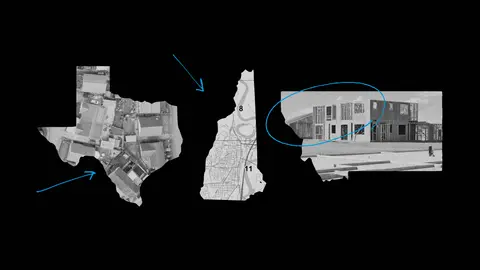
States are seeing similar results. Ilana Blumsack, senior housing policy analyst at Americans for Prosperity, points to Montana's bipartisan "Montana Miracle," which eased zoning, legalized duplexes and accessory dwelling units, and sped up permitting. Rents are already falling in Bozeman, and single-family home permits are rising statewide.
Texas and New Hampshire tell a similar story. Texas rents are falling faster than the national average, led by Austin, and Houston, which has pursued reform since the 1990s, has become one of the most affordable large cities in the country partly by allowing homes on lots as small as 1,400 square feet. New Hampshire just hit its highest level of building permit approvals in two decades.
What else is unlocking supply and stability?
Zoning reform clears the path, but builders and community groups are also changing what gets built and how existing homes get used. ICON, a construction company, can print the core structure of a home in 24 hours and complete it in eight days, with walls 350% stronger than code requires, at a fraction of traditional cost. Manufactured homes are an overlooked option too. A new manufactured home averages $124,800, compared to $424,176 for a site-built home.
Not every solution is about new construction, though. Shelters to Shutters, a national nonprofit, pairs housing with employment to help people stay housed through short-term crises before they become evictions. Participants have an 87% retention rate at their jobs, and 89% earn a promotion or wage increase within a year.
So, are higher housing costs actually fixable?
Yes, and the proof is already out there. No single fix closes a shortage of millions of homes on its own, but zoning reform, construction innovation, and platforms that make better use of existing housing are already working together in real places: Minneapolis, Montana, Texas, and New Hampshire. Progress on housing tends to start close to home, when communities remove barriers and share what already works.
Learn more about Stand Together's efforts to make the economy work for all, and explore ways you can partner with us.

Could this give America an edge on AI and energy?
These states have found a promising solution to housing

What’s holding back American innovation — and how to unlock it