



How are families doing in your community? What if a child welfare official told you that your county has the highest number of children removed from their homes and placed in foster care — in the entire state?
That’s exactly what happened a year ago in Wichita, Kansas.
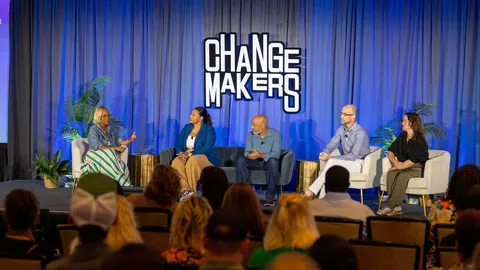
Around 100 community leaders, government officials, business executives, churches, and local partners gathered for an event hosted by the Kansas Department for Children and Families. The goal? To confront a troubling reality: Sedgwick County, home to Wichita, accounted for 20% of all children removed to foster care across the state.
“We did this giant diagnosis session to figure out why this was happening,” said Sadie Williams, regional manager for CarePortal, a platform that facilitates care-sharing support for families.
A powerful theme emerged. Many foster care cases in Sedgwick County are preventable, and prevention shouldn’t just be the responsibility of one agency — it should be a community effort.
“It’s not enough to just stop what’s happening in foster care,” said Williams. “We have to stop what’s feeding into it.”
That conversation about community effort sparked a grassroots movement. It became the catalyst for an initiative called Care for Every Family, a coordinated effort to align organizations, individuals, and resources around one shared goal: strengthening families before, during, and after foster care involvement.
So what does that actually look like? How does a community show up for its families in ways that keep them strong and out of crisis?
As a standalone intervention, foster care may be reinforcing an ongoing cycle
Each year, the United States spends over $31 billion on child welfare.
The child welfare system is built around three primary goals: ensuring children’s safety, securing permanent homes, and promoting the well-being of both children and their families. But are these goals being met in the long term?
Children who have been in the system face steeper odds on many fronts. They’re more likely to experience homelessness, become incarcerated, and struggle with mental health
“All of these things are both feeding into the foster care system and flowing out of the foster care system,” said Williams.
These outcomes suggest the child welfare system often falls short of its intended goals. It’s involved in too many families’ lives, and tasked with more than any top-down system can effectively manage.
What if we could prevent family crises in the first place?
Families and communities are better positioned to support children’s well-being than government organizations. Addressing the root causes of family stress before crisis hits can significantly improve outcomes — and a powerful way to do that is through strong local connections and caring relationships.
The child welfare system’s primary role should be addressing threats to children’s safety, with family separation reserved for cases where serious harm is imminent.
Wichita’s Care for Every Family initiative is raising awareness and building a community-based safety net to meet families’ basic needs and build connections before, during, and after foster care involvement. The initiative is prioritizing prevention by empowering local organizations and volunteers to support families and address challenges early, before a crisis results in government intervention or separation.
At the center is CarePortal, a technology platform that connects willing volunteers with families in need, helping to provide timely support and lasting relationships that can prevent government involvement.
The app connects with child welfare professionals, such as caseworkers and counselors, who identify and verify real needs within families. Once submitted, these requests are instantly shared with local churches, nonprofits, and volunteers who’ve signed up to help.
Beyond fulfilling material needs like helping with groceries or rent, CarePortal's deeper goal is to help families rebuild their social networks through meaningful human connections. That can be the critical difference that keeps a family together.
Every tough situation is unique
In Wichita, 28% of child welfare cases involve abuse — a clear safety concern that falls squarely within the child welfare system’s responsibility. However, for the other 72% of cases, the need for government intervention — or whether it is the best solution — is often less clear.
“What is the other 72%?” said Williams. “It’s neglect, most of which can be traced back to poverty. It’s not just physical and financial poverty. It’s social and relational poverty. It’s mental and spiritual poverty. It’s all of these different factors that are leading to the breakdown of the family.”
Neglect — poverty-related or not — is serious. The Kansas Department for Children and Families defines it as a parent or guardian failing to provide essentials like food, safe housing, clothing, basic medical care, or adequate supervision. When neglect is linked to poverty, community support and strong relationships often offer a more effective and compassionate response than relying solely on the child welfare system.
Rebekah Wedel, a foster-adoptive parent and local community member, said one statistic in particular stood out to her: 11% of foster placements in and around Wichita happen because parents or caretakers are unable to cope with the stress of parenting and life challenges.
“That speaks clearly about the needed role of prevention,” she said. “These families need support and community and resources so that they recognize, ‘I can still have my children in my home and actively be their parent, even in whatever crisis we’re in, because I have a support system.’”
For example, imagine a single mother faced with an impossible choice: stay home to care for her sick 5-year-old or go to work so she can make next month’s rent. On her own, neither option is good, and both carry risks. But if she has a trusted neighbor or friend who can step in and watch her child, she doesn’t have to choose between her child’s well-being and keeping a roof over their heads.
Stay up to date
That kind of relational support might seem small, but without it, a parent can quickly spiral into crisis, facing the loss of housing or even the loss of their child to the foster care system.
“A lot of people don’t have a safe person to turn to,” said Wedel.
However, as Williams and others in the community discovered, in Wichita, the issue wasn’t a lack of people willing to help — it was a lack of connection. Many people wanted to make a difference. They just didn’t know where to start.
Even local churches struggled. While eager to serve, they often didn’t realize how urgent the need had become or felt overwhelmed by the number of nonprofits asking for support. What they needed was a clear, focused way to engage — a bridge between their resources and the families who needed them most.
“There are so many wonderful resources in the Wichita area, whether that’s on the church side of things, businesses, nonprofits, school systems,” said Wedel. “Sometimes we kind of get siloed into our own little islands. There can be an impact on your own little island, but there’s potential for so much more — even just knowing about each other and what each other does.”
How do you coordinate support for families in a city of 400K?
The team behind Care for Every Family asked two key questions at the outset of working together: How can we raise awareness across the city, and how can we make it easy for people to get involved? They wanted to offer simple, actionable on-ramps — clear next steps for people who wanted to help — and bundle those options in an accessible, all-in-one resource.
This strategy gave rise to what organizers call an “air game” and a “ground game” to drive the initiative’s launch. Williams described it as a citywide movement created by the church, for the church, that could serve as a central hub for congregations to unite around the shared mission of supporting vulnerable children and families. The goal: to meaningfully engage at least 100 of Wichita’s 400 churches in this collective effort.
For the air game, the team partnered with a marketing agency to build awareness through data, storytelling, and targeted outreach. They also developed experiential training for pastors, congregants, and other leaders to better understand what families face, both before and during child welfare involvement.
On the ground-game side, they assembled a coalition of “equipping partners” — nonprofits that rely on church partnerships to wrap around families in crisis. These organizations collaborated to streamline their outreach, creating a “package deal” for churches aiming to offer clear, coordinated opportunities for engagement.
Together, they helped launch a website that serves as a one-stop hub, combining awareness, resources, and easy pathways to act. Pastors can now direct their congregations to a single source for both education and action. Whether someone wants to meet urgent needs through CarePortal, explore fostering or adoption, or become a “court-appointed special advocate,” the site offers multiple ways to get involved — all in one place.
The movement continues to grow, anchored by the belief that awareness must be paired with activation. When people are equipped with the right tools and relationships, compassion becomes action, and action has the power to keep families together.
“We’re not starting anything new,” said Williams. “We’re plugging what already exists into the technology to make it more streamlined and efficient, so that more people can get involved.”
What if care starts with your ZIP code?
Creating a resource was never the end goal. The real challenge was making sure people actually used it at the neighborhood level.
“We’re bringing together all the church leaders, stakeholders, community leaders, and school leaders in one geographical location and presenting them with data specifically about their ZIP code,” said Williams. “We tell them they can’t change the entire landscape of the county, but they do have ownership of their direct community.”
This local aspect is called Care in Action, and it kicked off with a ZIP code-based meeting that left a lasting impression. Wedel, who attended, said it deepened her commitment to the work. “I realized there are so many people who are also deeply passionate about this and want to see change,” she said.
The meeting began with a data walk, posters lining the room with striking local statistics about family well-being. “Participants were like, ‘Wait, my city? No, this can’t be happening in my city,’” said Williams.
What followed was a two-hour, eye-opening conversation about the realities in their own backyards.
“There was a healthy balance between ‘We all know this is not okay’ and ‘Let’s think of realistic, attainable, achievable steps, recognizing this is a long-game, multifaceted beast,’” said Wedel.
One major takeaway: Many local partners still weren’t using CarePortal. So, the group made it a community-wide goal to change that. They applied for and received a grant through the Care and Action Project, allowing churches to fund their responses through the platform.
Local school teachers also raised a concern — students from nearby group homes needed mentors. In response, church groups mobilized, organizing visits to help with homework, lead Bible studies, and simply show up with a steady, caring presence.
Since one of the leading causes of child removal in this ZIP code was parent or caregiver burnout, a local church committed to offering support resources to walk alongside families and help them stay together.
And across all these discussions, one truth kept surfacing: People need more connection. Churches began planning more community events — not just as programs, but as spaces where neighbors could simply do life together.
As Care for Every Family gains traction in Wichita, Williams hopes other communities will get inspired to take action. “The only thing that you can’t do is nothing,” she said. “Everyone can do something. This is about helping people connect and find that something.”
Care for Every Family and CarePortal are supported by Stand Together Foundation, which empowers individuals to reach their full potential through community-driven change.
Learn more about Stand Together’s efforts to build strong and safe communities and explore ways you can partner with us.
Our Take: What a customer-first mindset can teach nonprofits
At this nonprofit for veterans, feedback is key to decision-making.
In Conversation: Positive Tomorrows on strengthening families through opportunity