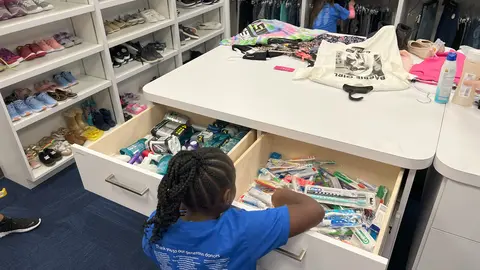




The national nonprofit Elevate USA had long imagined expanding its youth development model into Native American communities. “It was something that had already been on our hearts,” said Kevin Byerley, Elevate’s CEO. “Native students often have much less resources than the rest of the country.”
That long-held aspiration eventually led Elevate to the Navajo Nation in Arizona.
But the path there would take years of patience, humility, and a willingness to let the community set the pace. The ongoing result is a compelling example of a bottom-up approach, with Elevate staff working side by side with the community to adapt their model to empower Navajo Nation students to thrive.
A model rooted in relationships
Elevate USA’s model operates inside public schools across 19 cities, typically among economically disadvantaged communities, and focuses on building long-term relationships that empower students to thrive in school and beyond. Designed for students in grades 2 through 12, the programming has four core areas: accredited classes, mentoring, adventure experiences, and college and career readiness.
These programs are delivered by Elevate Teacher Mentors who form meaningful connections with students inside the classroom and in the community.
High school students mentor younger peers through the organization’s Little Elevate program, reinforcing a powerful cycle of leadership and self-actualization — creating what the organization describes as “generations upon generations of thriving leaders.”
And across Elevate’s national network, the model has shown strong outcomes. According to its 2024–2025 Impact Report, 68% of Elevate students hold a leadership position, students who participate in Elevate for three semesters or more go on to positively affect an average of 12 other peers, and 91% are on track to graduate — 10 points above the national benchmark for economically disadvantaged students.
Elevate’s engagement with the Navajo Nation began with what the organization calls “Listen and Learn” visits. Navajo elders and community leaders traveled to Denver to observe Elevate classrooms in action. Elevate leaders, in turn, spent years visiting Navajo communities.
Early conversations were intentionally nontransactional, with face-to-face exchanges at round tables.
“For six years, we were building a relationship,” said Adam Roybal, Elevate’s senior vice president of organizational development. “That time was about building trust, not business ideas.”
68%
of Elevate students hold a leadership position
according to Elevate's 2024-25 Impact Report
When urgency meets relationship
The pace of Elevate’s relationship-building shifted dramatically after 15 youth in one Navajo community died by suicide in one year. The youngest was only 11.
“That changed everything,” Byerley said. “There was an urgency we couldn’t ignore. Lives were at stake.”
Jacob James, an Elevate Navajo Teacher Mentor, was a kid himself when the young people took their lives, and remembers that there were few resources or opportunities that supported Native youth, whose suicide rate is 2.5 times higher than the national average.
James also remembers that the community was determined to rally around its young people after the initial shock of the tragedy.
“There was a sense of hopelessness,” James said. “But then hope sparked once people started implementing and finding ways to solve those problems.”
One response was to bring Elevate programming to the Navajo Nation, alongside other community-led efforts. Because relationships were already in place, community leaders were able to quickly partner with Elevate. Youth leaders, school officials, and even the Navajo Nation Office of the President and Vice President stepped in to vet the organization and shape what that partnership could look like.
For James, the experience planted a lifelong calling to return to his community, first serving on Elevate Navajo’s board and eventually becoming the first Teacher Mentor to be hired.
“[Elevate Navajo] was essentially birthed out of this vision for us to not ever have to live through a tragedy like that again,” James said.
There was a sense of hopelessness. But then hope sparked once people started implementing and finding ways to solve those problems.
Jacob James
Elevate Navajo Teacher Mentor
Redesigning a national model for local context
When Elevate Navajo officially launched in 2022, it did so as a locally governed affiliate with its own board, leadership, and staff.
“Our job at Elevate USA is to equip, not own,” Roybal said. “The community builds the organization. That’s the model.”
Elevate Navajo tailored the national model to meet the needs and context of its community, including cultural adaptations. In Navajo communities, direct eye contact — often encouraged in non-Native classrooms — can be interpreted as disrespectful, particularly with elders and authority figures. Teacher Mentors adjusted their approach, helping students navigate both cultural contexts.
Curriculum evolved, too. Entrepreneurship lessons were reframed around flea markets and traditional crafts: beadwork, leatherwork, and small-scale commerce already embedded in Navajo life.
“We give Teacher Mentors the curriculum as a tool,” Byerley said. “They’re the ones who paint the lesson for their students.”
Stay up to date
A classroom that sounds different
The impact of those adaptations became evident almost immediately.
In many Navajo classrooms, students observe quietly before engaging with peers and teachers. But on the very first day of Elevate classes at Window Rock High School, administrators noticed that Elevate classrooms were filled with conversation, movement, and laughter.
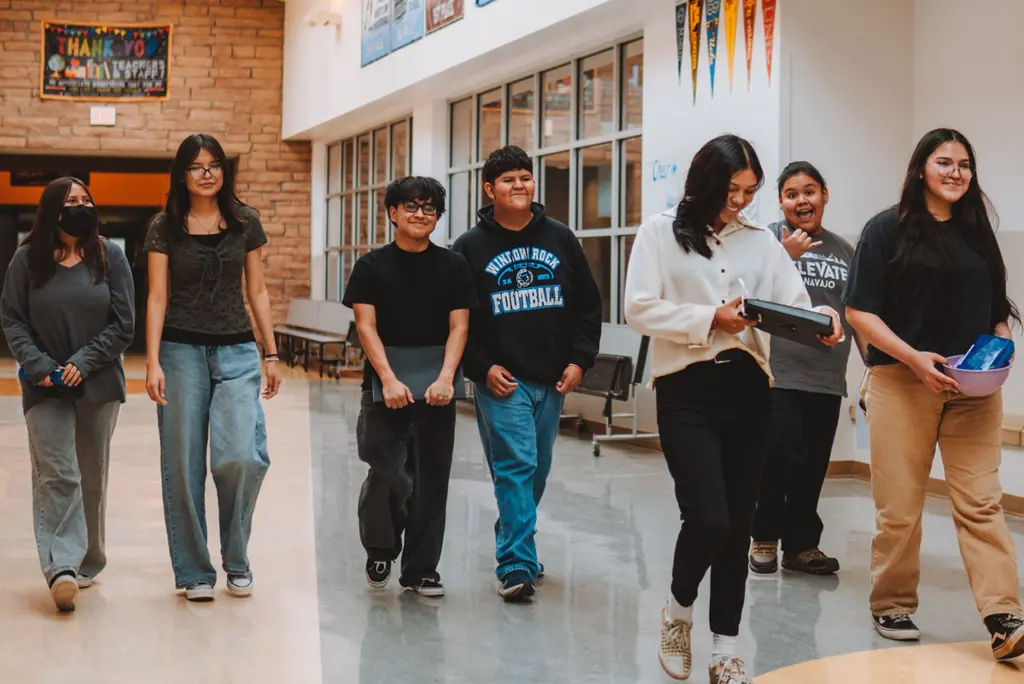
“During our launch year, an administrator commented, ‘Usually freshmen don’t even talk this much at the end of the year,’ and it was day one,” Roybal explained.
“Teachers told us these kids are getting to express themselves; they’re having fun,” Byerley added. “This was adding to the culture of the school.”
And students changed, too. Michael started Elevate classes like many other students: quiet and a little shy. However, when two of the Elevate freshman classes were combined, Michael came out of his shell and became a little disruptive in class. To help him get back on track, Elevate mentors told Michael they believed in him and challenged him to be more present.
Michael is now considered one of the school’s top students and encourages other students to stay focused in class. In response to a thank you card from Elevate teachers affirming his progress, Michael wrote, “Thank you for being here.”
Building for the future
In 2025, Elevate celebrated a milestone: 900 students graduated across its network. At the same time, the organization is fundraising to launch a new affiliate in the Crow Nation of Montana — drawing on relationships fostered through Elevate’s First Nations Council.
“The difference now,” Roybal said, “is that Navajo leaders are vouching for us. That trust carries.”
Elevate’s work in the Navajo Nation offers a compelling example of what’s possible when patience, local wisdom, and genuine community partnership take center stage.
In the Navajo Nation, that approach didn’t just build a program. It built trust and the conditions for young people to realize their potential as the work continues. For James, it also built a sense of ownership and accountability for his community.
“This is my community, this is my home — we need to protect it and provide resources for the kids here.”
Elevate USA is supported by Stand Together Foundation, which empowers individuals to reach their full potential through community-driven change.
Learn more about Stand Together's efforts to build strong and safe communities and explore ways you can partner with us.
In Conversation: How Army of Normal Folks helped turn a national bed build into local contribution
Our Take: What a customer-first mindset can teach nonprofits
At this nonprofit for veterans, feedback is key to decision-making.