



For too long, conversations about child and family well-being have been framed as an either/or:
- Either the government protects children — or communities support families.
- Either we take abuse and neglect seriously — or we recognize the role that poverty, stress, and isolation have in shaping family life.
- Either we place children in foster care — or we support families through community care.
This binary framing is not only misleading; it also limits our ability to truly keep children safe and help families thrive. Protecting children and supporting families is a both/and responsibility — one that requires a focused public child welfare system and strong, responsive community institutions working together.
The essential role of government: Protecting children from harm
Every child deserves safety. When abuse or neglect endangers a child’s life, government intervention is necessary. The foster care system — conceived as a system of last resort — plays a vital role in those cases.
Child neglect is a real, distinct harm, and it should not be minimized. Severe neglect accounts for a tragic share of child fatalities in the United States. In 2022, an estimated 1,990 children died from abuse and neglect in the United States. Neglect alone accounted for 76% of these child fatalities, making it the most common type of maltreatment among child victims who die.
The reality is that children are uniquely powerless because they cannot choose their caregivers, argue for what is best for them, or leave unsafe environments. Their basic freedom relies on the intervention of others when harm occurs.
We do not need to rank these threats to acknowledge them. Both abuse and neglect must be taken seriously, and both require a vigilant response from communities and the government. Further, protecting the powerless is a fundamental American value. Liberty for all is incomplete when we don’t act for those who can’t care for themselves.
Removal from the home should remain a last resort — reserved for cases where a child’s safety cannot be reasonably assured. On any given day, more than 325,000 children are in foster care. And children who have been in the system face steeper odds on many fronts: They’re more likely to experience homelessness, become incarcerated, and struggle with mental health. This is often a result of their system involvement, such as the instability of multiple placements, separation from siblings, and years away from familiar surroundings.
Raising children, even in the best circumstances, is demanding. Families — whether biological, kinship placements, or adoptive — benefit from support in navigating the physical and emotional challenges of caring for children every day.
The difference between crisis and stability often starts well before a call to child protective services. Addressing challenges early so they don’t metastasize into crises could help improve outcomes for children at risk of ending up in foster care.
Why upstream support matters
Stressors like unstable housing, lack of reliable child care, or the burden of meeting everyday needs can erode family well-being long before anyone hears about it.
For parents living with the daily weight of poverty, even small challenges — a flat tire, a sick child, an unexpected bill — can snowball and upend their lives.
Consider a single mother faced with an impossible choice: show up for her shift at work and risk leaving a sick child without care, or stay home and risk losing her job. These are not failures of love or intention. In these moments, a supportive community can make all the difference.
Stay up to date
The power of community: Mobilizing supportive networks
Civic organizations, faith communities, and neighborhood groups are often best positioned to meet families’ needs quickly, relationally, and with dignity. Across the country, social entrepreneurs are building new tools to strengthen these networks.
- Platforms like CarePortal connect families’ concrete needs to local churches and nonprofits in real time.
- Organizations like The Contingent mobilize community members to support families navigating difficult moments, helping prevent crises before they escalate.
- And then there are organizations like National Angels and Friends of the Children, which embody what happens when adults choose to walk alongside families and youth for the long haul.
That list just scratches the surface of the incredible local leaders who are finding new, innovative ways to support their neighbors.
These aren’t transactional interactions. They are relationships grounded in trust, encouraging resilience and hope. These models deliver resources and build relationships — the kind that help families weather hardship and reduce reliance on emergency systems altogether. They can respond in ways that government systems can’t, by showing up early and personally.
That support could include:
- Mentorship for caregivers and children
- Help with transportation or child care
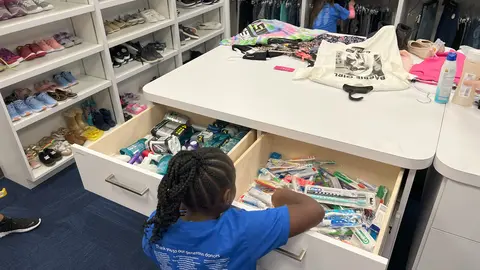
- Providing essential material goods (groceries, car seats, etc.)
- Showing up with emotional support
The bottom line: Communities and government are both essential to protect children and support families
A both/and approach to child and family well-being recognizes a simple truth: Children are safest when families are supported, and families thrive when communities are strong.
The government has a responsibility to protect children from harm. Communities have the capacity to help families before harm occurs and to help mitigate further harm when separation is necessary.
When public systems and community institutions work together as they should, we move toward a future where fewer families face crises, fewer children enter foster care, and more children grow up safe and supported in their own homes.
This is not about choosing between protection and prevention. It’s about investing in both — and finally moving beyond a false choice that has held families and children back for far too long.
That future doesn’t require choosing between government and community — it requires recognizing that both can play critical, distinct roles. When we break free from the false choice of either/or, we unlock a pathway where every child can belong — in their families and in their communities.
The Stand Together community partners with changemakers who are tackling the root causes of America’s biggest problems.
Learn more about Stand Together's efforts to build strong and safe communities and explore ways you can partner with us.
In Conversation: How Army of Normal Folks helped turn a national bed build into local contribution
Our Take: What a customer-first mindset can teach nonprofits
At this nonprofit for veterans, feedback is key to decision-making.